
Everything you need to write about The Matrix.
Fact sheet, founder bio, story angles, quotable lines, logos, screenshots, and the shortest path to a real human. Use anything here without asking. And if you need something we haven't prepared, email and I'll turn it around fast.
The short version.
The things a reporter usually asks first, in one table.
| Product name | The Matrix |
|---|---|
| One-line description | You drop scans in a folder; they file themselves on your laptop. A$29/mo, no cloud, no per-page costs. |
| Who it's for | One person who is personally drowning in scanned PDFs. Invoices, work orders, timesheets, statements, tax docs. Not a team. Not a department. You and your laptop. |
| Company | ChunkLand (sole-trader entity) |
| Founder | Chris McKenzie |
| Founded | 2025 |
| Country | Australia |
| Pricing | A$29 / month, single tier. One person, one computer. No other tiers. |
| Try it | 14-day money-back guarantee. A$29/mo. Cancel any month by replying to the setup email. |
| Setup mechanic | Customer emails 3-5 of their everyday scanned documents to setup@chunkland.com. Chris hand-configures a Matrix install around those exact documents and sends back an install kit inside 48 hours. |
| Where it runs | Locally, on the customer's computer. No cloud upload. No documents leave the device. |
| Platforms | Windows 10/11 · macOS 12+ (Apple Silicon & Intel) · Linux (AppImage) |
| Current version | v1.3.2 (June 2026). Local document recognition and filing; optional email intake; 5-minute polling cycle; unlimited batch size |
| Tech stack | Python core, FastAPI, SQLite, Stripe (billing only. Never sees document data) |
| Live URL | https://matrix.chunkland.com |
| Press contact | hello@chunkland.com |
Why The Matrix exists.
The Matrix exists because one person, sitting alone at a kitchen-table laptop, can quietly drown in scanned paperwork. Invoices from the trades. Work orders. Timesheets. Bank statements. The tax docs that arrive in a flurry every July. The receipt for the rangehood that was supposed to be on the warranty claim. A folder full of files called scan_00347.pdf with no idea which one is which.
I started building The Matrix because I was that person. I'm an electrical-trade-background guy who runs his life off a scanner and a folder structure, and I spent more weekends than I want to admit splitting 200-page PDF dumps into individual documents and renaming them by hand.
For nine months I tried to sell this as a multi-seat business platform. Wrong call. The people who actually wanted it were the ones doing the work — planners, site admins, supervisors, contractors, sole traders — drowning in scanned work orders, permits, timesheets and invoices, who didn't want a sales call, didn't want a per-seat plan, and absolutely did not want to upload their documents to somebody else's cloud. So I cut the SKUs and made it one thing: A$29/month, your computer, your folders.
The existing answers all arrived wrong-shaped. Document-management vendors want you to tag things after the fact. Cloud doc-filers want your scans on their servers and charge per page. None of them know what your paperwork actually looks like. And that's the whole problem with a one-person operator: the documents are weirdly specific, and they're yours.
So The Matrix flips the model. You email me 3-5 of the documents that actually fill your scanner each week. I read them by hand and ship back an install kit configured around those exact documents. The recognizers, the folder library, the launcher for your OS. From the day you install, scans dropped into a watched folder split, name themselves, and land in the right folder on your disk. Anything unfamiliar parks in UNKNOWN/ for you to look at. The runtime is deterministic. No model calls, no tokens, no usage dashboard. You pay A$29/mo whether you scan ten pages a day or a thousand.
The personalisation is the moat. Anyone can publish a generic doc filer. Nobody else hand-builds the recognizer set off your real samples. That's what makes The Matrix a product, not a script.
Where a piece could land.
Five angles that have nothing to do with "another doc app". Pick one, mix two, ignore them all.
The one-person paperwork tax
Self-employed operators, trades, freelancers, and household admin-keepers spend an unglamorous slice of every week on scanned PDFs. Nobody writes about that workload because nobody on it is loud about it. The Matrix is a product built explicitly for that one person.
The anti-cloud bet
While the rest of the doc-tooling category sprints toward cloud upload and per-page pricing, The Matrix ships in the opposite direction: scans never leave the customer's machine, and the price is a flat A$29/mo regardless of volume. Why one solo founder thinks that's the right call in 2026.
Configured by hand, not by model
The runtime path has no model calls. The personalisation happens once, up front, when Chris reads the customer's sample documents and writes recognizers for them by hand. The customer pays a fixed monthly fee. Not a per-document bill that grows with their paperwork. A piece about the unit economics of refusing to put a model in the hot path.
Sold like 1998, shipped like 2026
No self-serve checkout. No sales call either. You email a human a few sample PDFs; a human emails you back an installer 24-48 hours later. A product where the onboarding is a conversation, on purpose.
Built in public by an electrician
Chris McKenzie isn't a career SaaS founder. He's an electrical-trade-background operator who got fed up with his own paperwork, taught himself enough to ship a product, and now runs the whole thing. Code, support, billing. Out of one inbox. A founder story without the usual pedigree.
The "loud failure" design choice
Anything The Matrix can't recognise lands in a folder called UNKNOWN instead of being guessed at. It's a deliberate choice in a category where every competitor's worst behaviour is silent misfiling. A short piece about why "I don't know" is a feature.
About Chris McKenzie.
Chris McKenzie is the founder of ChunkLand and the sole developer behind The Matrix. He comes from an electrical-trade background, not a software one. He taught himself to ship code because he was personally drowning in his own scanned paperwork and couldn't find a tool that fit. Every existing option either wanted to upload his documents to somebody's cloud or charge him per page to do something a folder structure should already do.
The Matrix is the product he built for himself first. The version customers install is the same code Chris runs on his own desk. He handles the setup emails, hand-builds each customer's recognizer set, writes the support replies, and ships the updates. ChunkLand is, at the moment, one person with one inbox. And that's the point.
. Based in Australia. Reachable directly at hello@chunkland.com.Pull-quote-ready, in case you're on deadline.
Five short lines from Chris you can drop straight into a piece. Paraphrase freely.
"There's one person in every household and every one-person operation who quietly does all the paperwork. They've got a folder full of scan_00347.pdf and a vague memory of which one is the warranty claim. That's who I built this for."
"I spent nine months trying to sell this as a small-business tool. The people who actually wanted it were individuals, on their own laptop, with their own paperwork. So I cut the SKUs and made it one thing."
"You email me three to five of the documents that actually fill your scanner. I read them by hand and ship you back an install kit configured for those exact documents. From there, you drop scans in a folder and forget I exist."
"Anyone can publish a generic doc filer. Nobody else hand-builds the recognizer set off your real samples. That's the difference between a script and a product worth paying for."
"One price. One tier. A$29 a month whether you scan ten pages a day or a thousand. No seat-counting, no per-page bill, no sales call."
"Your scans never leave your computer. There's no upload endpoint to leak from. one doesn't exist."
Direct downloads, high-resolution.
Right-click / save-as works fine. Use in press, reviews, podcasts, conference decks. Please don't modify the mark. Colour-shift, stretch, or add outlines.





The product in one frame.
The hero still shows The Matrix at work. Raw scans being ingested from a watched folder and sorted into named documents in folders the customer chose.
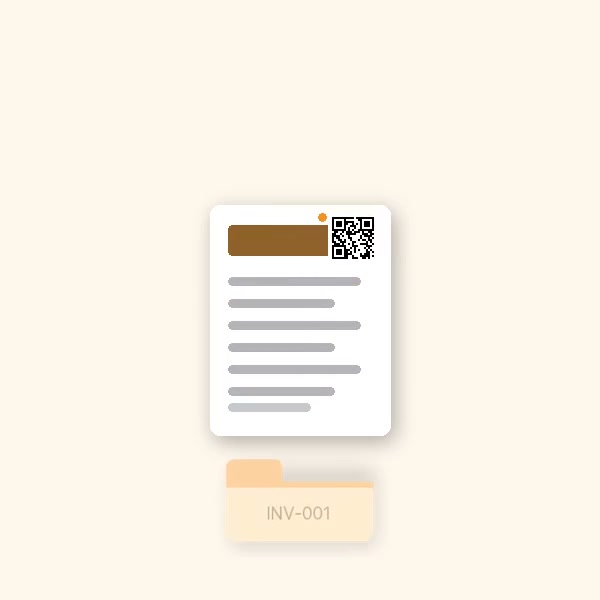
The flow in one paragraph: a customer emails Chris as many sample documents as they have at setup (the more the better for accuracy). Chris reads them by hand and ships an install kit with a provision.json tuned to those exact documents. From the day they install, scans dropped into a watched folder are split, named, and routed into the right folder by deterministic recognizers running locally on the customer's own machine. Anything unfamiliar lands in UNKNOWN/ for human review. The operator never types a filename.
The orange palette, in hex.
Warm orange on cream. Brown ink. Avoid reversing to a dark background or adding drop-shadows to the mark.
One-paragraph "About ChunkLand", for the bottom of your piece.
Copy as-is, or trim.
About ChunkLand. ChunkLand is a one-person Australian software shop founded by Chris McKenzie. Its first product, The Matrix, is a document-filing tool for the people buried in scanned operational paperwork — work orders, permits, timesheets, invoices, inspection reports. Customers email a handful of their everyday documents at setup; Chris hand-configures a Matrix install around those exact documents and ships it back. The customer drops scans into a watched folder and the files split, name themselves, and land in the right folder on the customer's own laptop. Nothing is uploaded to a cloud. The Matrix is A$29/month, one tier, with a 14-day money-back guarantee. Matrix.chunkland.com.
One inbox, one human, fast replies.
Press inquiries
Email hello@chunkland.com with your outlet, your deadline, and what you need. Replies usually inside 24 hours. Happy to do interviews, provide additional assets, or walk you through the product live on a screen-share. The founder will be the one answering, because the founder is the only one here.
Email the press desk